
lumber yards, building supply, B2B ecommerce, B2B CMS, ToolSwift
October 20, 2025
Lumber Yard CRM: Why It’s Not Enough Anymore
Most lumber yards don't have a sales problem; they have a workflow problem. Quotes are written but never closed, managers discover dormant accounts too late, and sales representatives often spend more time chasing information than finalizing deals. While the traditional advice has been to "get a CRM," a standard CRM alone is no longer enough for modern lumber yards and building materials distributors.
Stripe, Online Payment, Invoices, Payment Integration
October 2, 2025
How to Integrate Stripe Payment with ToolSwift for B2B eCommerce
In today’s digital marketplace, efficient and secure payment processing is essential for any B2B eCommerce business. Stripe offers a powerful and easy-to-integrate solution that simplifies online payments while providing a range of advanced features. By integrating Stripe with ToolSwift, you can manage B2B transactions effortlessly, automate billing and invoicing, and ensure a seamless customer experience.
Integration, Documentation, Google Merchant Center, Products, Google Shopping, Shopping Online
October 6, 2025
How to Integrate Your Website with Google Merchant Center for B2B eCommerce
Connecting a B2B ecommerce website to Google Merchant Center is increasingly essential for distributors, wholesalers, and manufacturers to make their products visible online. Google Merchant allows product listings to appear across Google Shopping and Search, helping contractors discover products earlier in the purchasing process—even before they reach out to sales teams. Unlike traditional DTC setups, B2B ecommerce introduces added complexity, including extensive catalogs, product variants, customer-specific pricing, and controlled product visibility. Successfully integrating Google Merchant in a B2B environment requires an approach that can handle these requirements while keeping product data accurate, compliant, and consistently synchronized as the business scales.
Integration, Documentation, Google Merchant Center, Products, Google Shopping, Shopping Online
September 29, 2025
How to Integrate Your eCommerce Website with Google Merchant Center
Many merchants use platforms like Shopify and WordPress with WooCommerce to connect their product data to Google Merchant, as integrating your website with Google Merchant Center can significantly improve product visibility, attract high-intent shoppers, and increase qualified traffic to your online store.
Email SMTP, SMTP Configration, Email Notifications, Automatic Emails, Email Updates
October 27, 2025
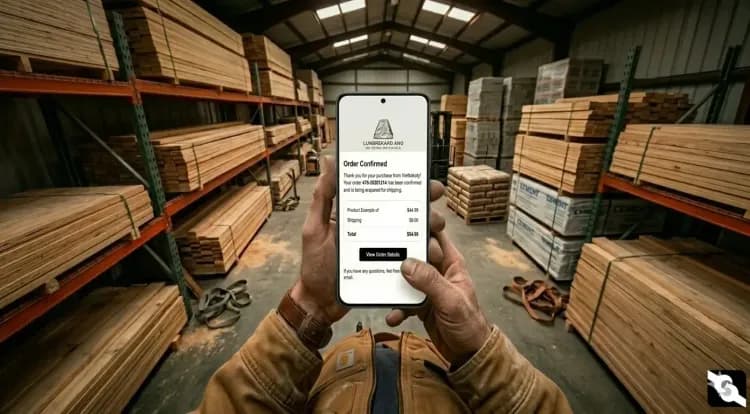
How to Configure SMTP in ToolSwift for Email Notifications
Updates are essential to keep B2B operations moving, and email notifications are one of the best ways to send quote updates and order confirmations to contractors. SMTP configuration is the step that allows distributors to send these email updates from their own business email. This guide helps admins configure SMTP in ToolSwift in just a few simple steps, without technical experience or developer support.
Integration, Documentation, Versapay, B2B Payments, B2B CMS, Invoices, Accounts Receivables
October 13, 2025
How to Integrate VersaPay Payment with ToolSwift for B2B eCommerce
Versapay is a payment and accounts receivable solution designed for B2B ecommerce businesses that operate with credit terms, invoices, and customer-managed payments. When integrated with ToolSwift, Versapay allows merchants to offer flexible payment options while maintaining control over invoicing and receivables. This guide explains how to connect Versapay to your ToolSwift account and what to expect once the integration is enabled.
Integration, Documentation, Google Merchant Center, Products
September 24, 2025
How to Sync ToolSwift Products to Google Merchant Center
Having products on your B2B ecommerce platform alone isn't enough to sell online. Google Shopping is the largest product‑discovery surface on the web, letting you show your catalog to Google users in your region. To show your products on Google Shopping (Free listings and Shopping ads), connect your ToolSwift account to Google Merchant Center (GMC) using Google's Content API for Shopping. Don't stress—this guide walks you through every step, including how to get your Google OAuth Client ID and Client Secret from the Google Cloud Console, connect ToolSwift to your Merchant Center account, map your product data, and run your first sync.
Integration, Documentation, B2B Payments, Versapay Payment, Apple Pay, Google Pay
October 16, 2025
How to Enable Apple Pay and Google Pay on ToolSwift Using Versapay
Apple Pay and Google Pay give customers a faster way to pay invoices and orders without compromising the controls required for credit terms, invoice tracking, and secure payment processing. This guide explains how to enable Apple Pay and Google Pay in your VersaPay account and outlines the steps ToolSwift takes to complete the setup, including domain verification and final activation. Let’s start with enabling Apple Pay.
Integration, Documentation, B2B Payments, Stripe Payment, Apple Pay, Google Pay
October 9, 2025
How to Enable Apple Pay and Google Pay on ToolSwift Using Stripe
Enabling Apple Pay and Google Pay helps customers complete checkout faster by using saved payment details on their devices. When connected through Stripe, these digital wallets improve conversion rates for B2B eCommerce businesses while maintaining secure payment processing for your store. This guide walks ToolSwift admins through enabling Apple Pay and Google Pay for your ToolSwift storefront using Stripe.
Automated Emails, Email Notifications, Email Customization
October 23, 2025
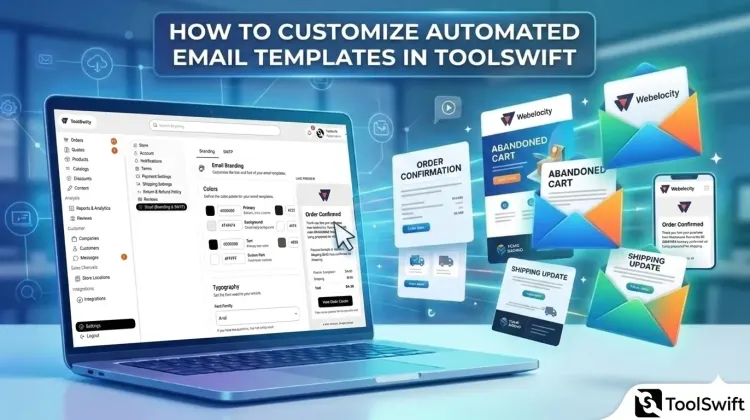
How to Customize Automated Email Templates in ToolSwift
Automated emails are an important part of the customer experience. From order confirmations to shipping updates, these emails keep customers informed about their order updates. With ToolSwift, store administrators can customize the appearance of automated email templates to match their brand identity. This ensures that every message sent to customers reflects the store’s branding while ToolSwift handles the automation behind the scenes. In this guide, you’ll learn how to customize automated email templates in ToolSwift and create branded emails that match your store’s identity.
Getting Started, Guide 2026, ToolSwift, Dashboard, Pro Account
March 31, 2026
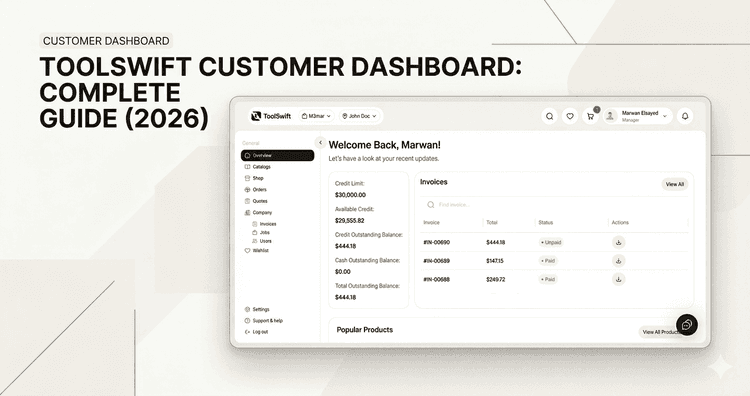
ToolSwift Customer Dashboard: Complete Guide (2026)
Learn how to navigate the ToolSwift Customer Dashboard, find products faster, manage quotes and orders, and access company tools like invoices, jobs, and users (when enabled). This guide is a complete walkthrough of the customer portal experience.

AI, Artificial Intelligence, B2B eCommerce, ToolSwift, Machine Learning, Large-Scale Catalog Management, Predictive Pricing, Dynamic Catalogs, AI-Powered Search, Automated Reporting Assistants
November 3, 2025
How AI is Transforming B2B eCommerce Operations
In the world of B2B distribution—whether you're moving lumber, electrical supplies, or industrial hardware—the "old way" of doing things is hitting a ceiling. Manual reporting, spreadsheet-based inventory tracking, and static pricing are no longer enough to keep up with rising buyer expectations. The shift is here: AI in B2B eCommerce is moving from a "nice-to-have" feature to the core infrastructure of modern wholesale operations. For distributors, AI isn't about replacing human expertise; it’s about giving your team the tools to work faster, reduce errors, and uncover hidden revenue. At ToolSwift, we are building the next generation of AI-powered tools specifically for the complexity of B2B workflows.
Integration, Documentation, ShipStation, API, B2B eCommerce, Shipping
March 26, 2026
How to Connect ShipStation to ToolSwift in Minutes (No Developer Needed)
If you're running a B2B ecommerce store on ToolSwift, shipping shouldn't slow you down. Connecting your ShipStation account to your ToolSwift admin dashboard takes just a few minutes, requires zero coding, and — most importantly — you'll never have to share your ShipStation login with anyone. This guide walks you through the entire ShipStation API integration step by step, so you can start managing labels, rates, and fulfillment from one place.
ToolBX alternative, ToolBX vs ToolSwift, B2B eCommerce platform, Contractor portal, Building supply software, Lumber yard software, Dealer eCommerce AI quoting
July 26, 2026
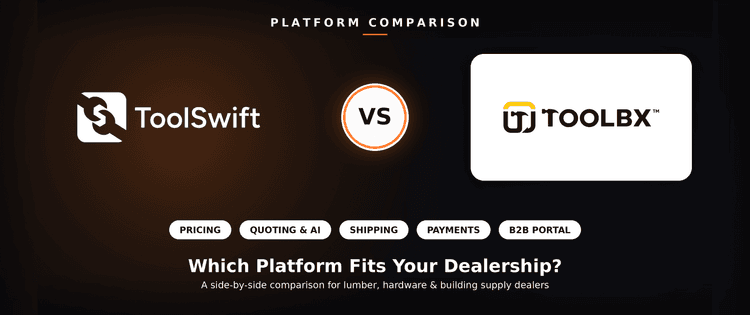
Considering ToolBX Alternatives? A Direct Comparison with ToolSwift
Compare ToolBx vs ToolSwift for B2B eCommerce, contractor portals, AI quoting, pricing, shipping, payments, and multi-location dealer management.
BisTrack alternative, BisTrack vs ToolSwift, B2B eCommerce platform, Contractor portal, Building supply software, Lumber yard software, Dealer eCommerce AI quoting
July 30, 2026
Considering Epicor Commerce (BisTrack) Alternatives? A Direct Comparison with ToolSwift
Compare Epicor BisTrack vs ToolSwift for B2B eCommerce, contractor portals, AI quoting, pricing, shipping, payments, and multi-location dealer management.
Unilog alternative, Unilog vs ToolSwift, B2B eCommerce platform, Contractor portal, Building supply software, Lumber yard software, Dealer eCommerce AI quoting
August 3, 2026
ToolSwift vs. Unilog CX1: A 2026 Comparison for Distributors Evaluating CIMM2, Sigma, and Essentials
Compare Unilog vs ToolSwift for B2B eCommerce, contractor portals, AI quoting, pricing, shipping, delivery, and product and catalog content.

